Friday, March 28, 2014

Turner UniDrive Company

Industry Review continues with a look at spot #342, the Turner UniDrive Company.

The building's physical location corresponds with the one identified on the 1972 track diagram as spot #342, but the industry list shows that spot as "Open".  I presume that's the Frisco's way of saying we don't provide service there any more.

According to the company's history, they've been in this location since 1940.  The business line is industrial gearboxes and transmissions.  In the early years, it is quite conceivable that they received raw stock for machining by rail.  Trucking probably later took over this raw materials delivery, but it's also plausible that rail was still viable for some specialized inbound component or outbound finished assemblies.

The overview shot of the Terrace St. side of the building above reveals where the three rail served dock spots were located and these close-up shots show the detail of the brick work:


The building is built into the hillside and a basement level is accessible from around the south end of the structure:


One certainly gets a feel for the grades involved on this spur -- The main Fairgrounds branch track is just out of view to the left of the photo above and sits about three feet lower at this point.  The upper level track following Terrace St. was immediately to the right of this building and ten feet higher.  These two tracks joined together about four-hundred feet south of where this photo was taken.

I'll close with a few detail shots showing the special brickwork on this structure and the fact that at the southern tip, it isn't very wide.


One final shot showing the relative location of this property to its neighbors.  The docks in the foreground are the remains of an oil dealer that used to have tanks at the upper left (along Terrace St.)

Rehold, Inc has records indicating that this company also may have done business under several different names starting in 1964 and, presumably, ending at or before 2009:
  • Associated Machine Company
  • Enterprise Machine Company
  • Partnership Machine Company
  • Quality Machine Company
  • Ro-Da-Ga Machine Company
  • Ross Machine Company
  • W. S. Sitton Machine Company


Tuesday, March 18, 2014

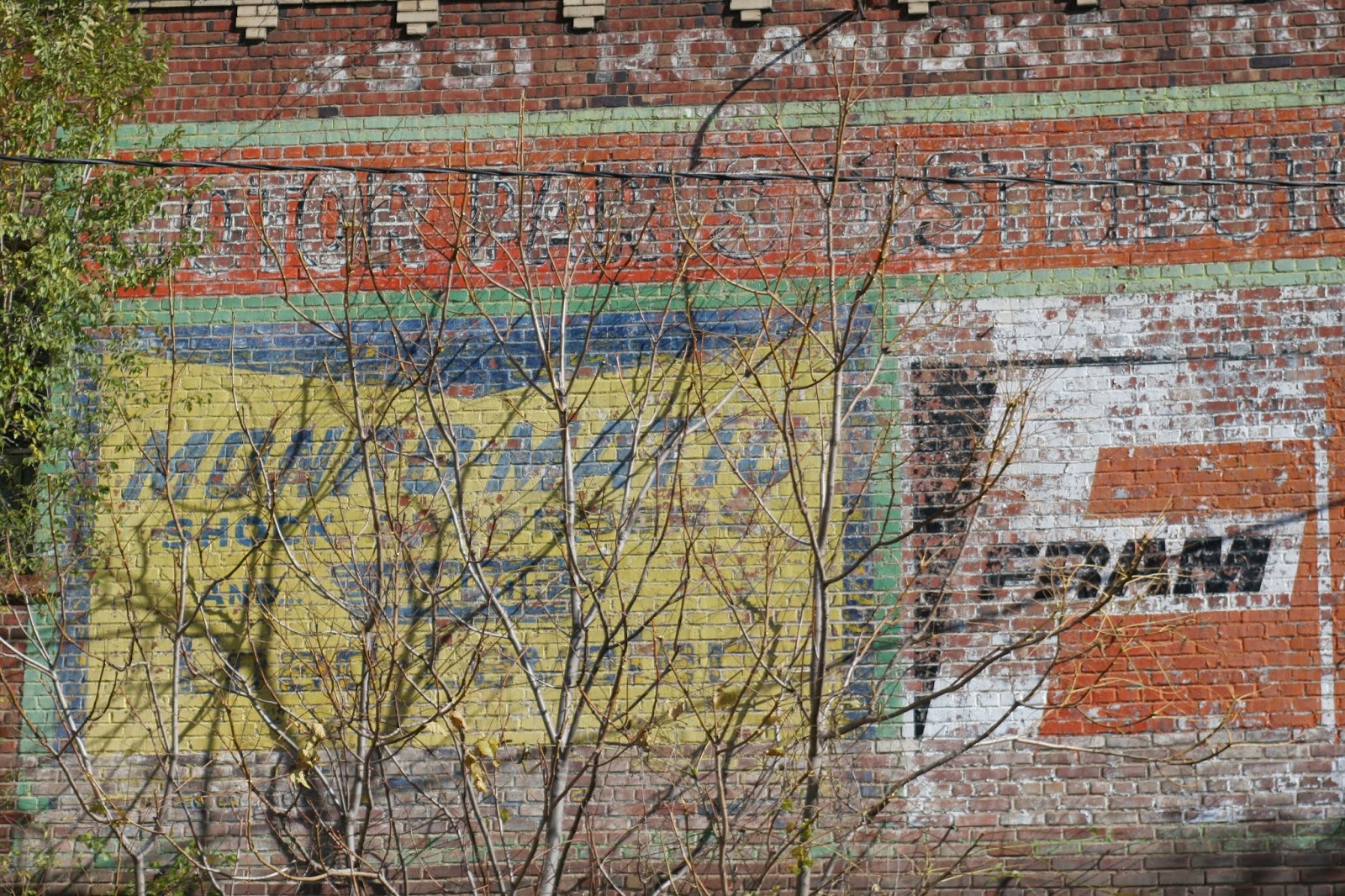
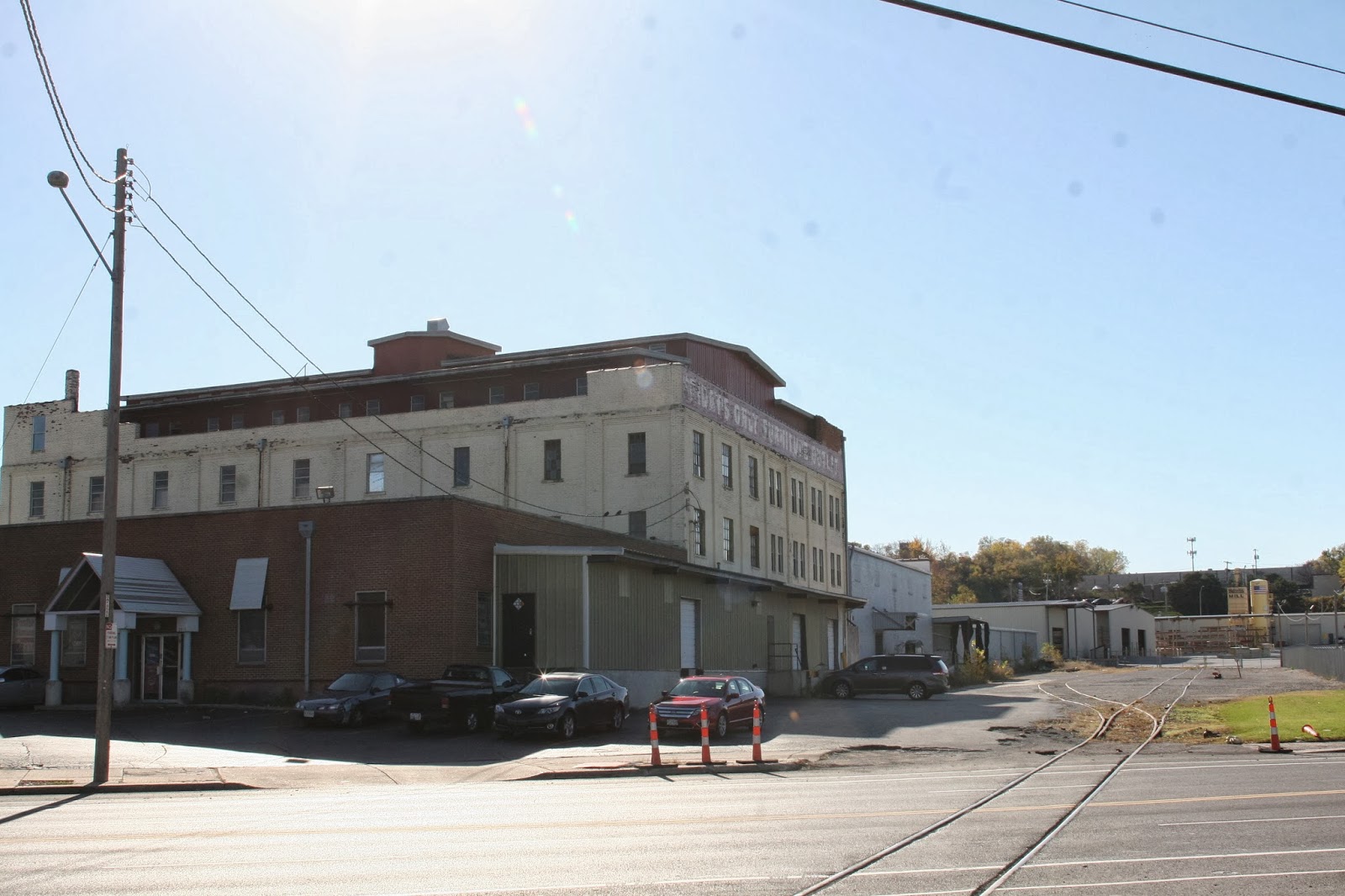
Motor Parts Distributors

Industry Review continues with a look at spot #336, Motor Parts Distributors.  A relatively new business in my intended era, having been registered in October 1961.  Prior to that Columbia Bedding was located here according to the most current Sanborn Maps as 3321 Roanoke Rd.  When Motor Parts Distributed was incorporated, the address was listed as 3331 Roanoke Rd., and as of the current day, the property is listed as being at 3300 Terrace St.  Motor Parts Distributors was out of business by August 1994.

We'll start with an overview of the cluster of buildings along the tracks here.  Motor Parts Distributors was the curving building at the far end.

Zooming in on that final building reveals some ornate concrete details along the top and clearly displays the curved nature of the structure.

I captured some closeup shots of the painted signage on the building.


After studying the track diagram, the Sanborn Map and the GIS data, and the following modern aerial photo, the property also consists of two structures on the upper level closer to Terrace St.

The northernmost (upper) building visible from above is a brick affair built into a just above the hillside.


The Quonset hut structure between the two is apparently connected to the second floor of the lower building and was likely used for some amount of shipping or receiving.  Note the "MPD" lettering that's still on the building to the right of the door.

The Frisco industry diagram shows active rail spots at both the lower doors on the main brick structure as well as the upper dock on the Quonset hut structure (separately listed as spot #336-1).

Unfortunately, since this company was dissolved prior to the dawn of the internet, there's very little information available online.  I was able to track a couple of links to the business owner (RICHARD F. MILLARD, JR) and saw that they were specifically hiring a woman (!) in 1974 for general office work, but that's about the extent of it.

Perhaps further research can be conducted at the local library.  Until then, I'll have to go with conjecture and assume that various carloads of auto parts were received at this location for local distribution.  Considering that having "distributor" in it's name and based on the relatively small size of the facility it is quite unlikely to have been involved in the production of automotive components, though there are major plants in the metro area for both Ford (Claycomo) and GM (Fairfax).

Sunday, March 2, 2014

Paper Supply Company

Industry Review continues with a look at spot #306, the Paper Supply Company.  The main building was a four story brick affair, plus there was an single story warehouse extension of the building to the south.

According to a 1961 article in the Kansas City Star, the Paper Supply Company moved into this location in October of that year.  Immediately prior to that the Thompson-Hayward Chemical Company was located here since 1917 or so.  It is not surprising that THCC moved out of this location and dissolved their operation here since they just suffered an industrial accident in April of 1959.


Paper Supply operated as a mill agent and distributor of printing, industrial, and specialty papers.  According to this source, there are documents on file for the 1980 purchase of Standard Paper and another transaction involving CDA Papers in 1986, so it's reasonable to assume that the company remained strong.  It shouldn't require any stretch of reality to spot several boxcars of paper on their spur during my intended modeling period.

Saturday, March 1, 2014

Pacific Mutual Door Company

Industry Review continues with a look at spot #326, the Pacific Mutual Door Company.  According to the abbreviated history their website, this location was established in 1952 when the company rebuilt their local operations following the floods of 1951.

Aerial views in 1959 and 1969 show what appears to be a single boxcar spotted at the facility.  Commodities would likely be inbound lumber for the millwork department or plate glass for inclusion in windows.   Perhaps in later years, some windows or doors were received directly as they expanded into a role of local distributor for national brands.

Historic Aerials has a long gap in coverage, and by 2006, the tracks are gone.  I particularly like this view along with the street view one that shows the spur elevated above the climbing right-of-way.

This elevation change means that this will be a signature scene.

There were four direct rail doors and the rear portion of the building was set back slightly to accomodate an outdoor dock.


Friday, January 17, 2014

Carthage Marble

Industry Review continues with a look at spot #315, Carthage Marble.  While still in business, rail service has long disappeared.  The most interesting feature here is the overhead crane for unloading cut stone from rail cars.

(click on the pictures for larger views)


I've preserved a reference to the modern day Google Street View of the building for browsing the property.

A close-up look of the fence line shows the the gate between the marble property and neighboring Schutte Lumber where the rail spur ran.

A check of the city property data shows the relationship of the the right-of-way to the surrounding properties.

The exercise remaining for this modeler is to determine the era-appropriateness of rail service to an industry like this.  I'm sure cut stone had its heyday when there was no competition from a highway system and trucks.  The quarrying side of this industry is covered quite well in Industries Along the Tracks Vol. 4 by Jeff Wilson and that publication has a few pictures from the late 1970s of raw cut stone block loaded into gondola cars.  Finishing, including further cutting would likely take place at a local retailer or wholesaler like Carthage Marble.

Rail shipments of this commodity have likely dwindled to near zero in recent years.  One source I found was a mid-to-late-90s NAFTA freight study that looked at commodity flows through the greater Kansas City area.  That report makes mention of cut stone products being exported to Mexico, but indicates that the shipments were handled by truck.

Sunday, December 8, 2013

Crisis of Scale

The first post on this blog noted the transition of my modelling interests from heavy mainline coal hauling action to short industrial spurs and switching.  I'd previously been fairly dedicated to acquiring equipment to support the former and luckily my era interests (mid-70s to early 80s) haven't changed so some of it is reusable for the latter.

However, my recent internet wanderings have led me down the path of potentially switching to O scale (specifically P:48) for this Frisco Hill Track endeavor.  Why you ask?

A few of the more interesting blogs that I follow (Lance Mindhiem, Mike Cougill, Trevor Marshall, et. al.) have posted in the past about what drives anyone in this hobby.  Most build a model railroad to have something "come alive" for them and that something varies for everyone.  Often it is childhood memories or the thrill is derived from having 12-15 people execute T&TO operations across a long mainline.  I've found that what I seem to most enjoy is the close-up simulation of the switching.  Almost as if I could be the conductor or engineer without having to get up at 2am and work in the freezing cold.

In thinking about how to recreate that for my own enjoyment, there are a few aspects of the larger scale that are appealing to me:
  • The overall mass of the objects conveys a greater sense of realism
  • Greater detail
  • Sound -- specifically the opportunity for larger speakers to generate more bass
  • Potential for battery power -- Imagine being freed from feeders!
  • Working handbrakes -- Think accessory decoder and small actuator to engage brakes on each car.
  • Room for batteries and speakers aren't a problem if combined with powered trucks.
    • Kato recently brought them out on the GE P42
    • NWSL also has the Magic Carpet
None of these things require the larger scale, but most are made easier by it.  One thing I remain perplexed about regarding O-scale is the scaling  Seems most rolling stock produced today follows 1/4" (except for wheelsets, but Protocraft has the solution there), though I'm unsure if the concessions made by the manufacturer to simultaneously release a 2-rail and 3-rail model affects this aspect.

Well, that's all from the armchair (keyboard?) modeling department this evening.


Thursday, November 14, 2013

Boots On The Ground

I had an opportunity to visit Kansas City this past weekend and spent some time exploring the Hill Track in person with some model railroad friends.  I'm still working on getting through the pictures and will post the more interesting ones here soon.

The most notable detail learned from the trip was the elevation changes that the line experienced.  While some of that information can be gleaned from topographic maps, nothing beats the in-person experience and GPS readings (thanks Keith & Mark!).

At just over a mile in total length and with a total elevation change of 100 ft, the average grade works out to be 2.2%, which is towards the steeper end of the spectrum for railroad grades.  Of course, this is a small industrial spur but the laws of physics still apply.   Most spurs from the main track were level, so that adds to the visual interest of the scenes.

The one thing I regretted not doing while there -- I only thought of it while on the plane back home -- was to measure the two remaining switches on the line.  I'd like to use that as a key input to the planning.  "Standard" model railroad switches are often too small compared to what scaled-down versions of the prototype would be for similar use cases.  I plan to rectify that and use switches in the #8 to #10 range plus curves as broad as I can justify to avoid a crammed look.